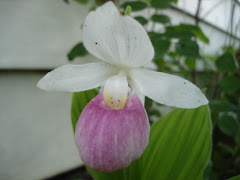
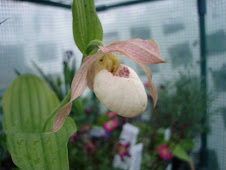
Cyps generally develop quite qiickly once the shoots break the soil. You can see that after another week, the potted Cyps on my growing shelf are really coming along. Pics in order: C. reginae, C. parviflorum, C. pubescens, C. 'Gisela'.


 The top photo is the Cyp. parviflorum var. pubescens I pictured a week ago, with its leaves fully unfurled. It won't flower this year although it did last year; this I find is common with this species. After they take a year off however, they produce larger and more flowers the following year. The second pic is the Cyp. reginae I pictured earlier, still slowly, as reginae does, emerging. The third pic is another pubescens which I brought in a week ago, just peeking through. This one should (hopefully) flower - it flowered on two stems last year. It seems to have suffered some frost damage from the pot being plunged too high in the hole in the ground. I have also brought in a 'Gisela' which has not appeared yet.
 Yesterday evening I decided to move my oldest Cyp. reginae plant, which bloomed for the first time last year, to a more favorable location in the garden. I gave it better soil, and a little more shade; the previous area was borderline too hot. It had nice long, healthy roots, so I dug it a bigger hole, as well. Soon I plan on moving my oldest Cyp. pubescens as well; it is getting too much shade and won't multiply.


 Regular readers of this blog will know that I grow a lot of Cypripediums, or hardy lady's slippers. I am experimenting with growing C. parviflorum (second pic) and C. reginae (first pic) in pots, which allows me to "wake them up" earlier in spring than the plants in my garden will rise (these are active at least a month before the garden plants will be). I am also growing some second year Cyp seedlings this year: C. californicum (third pic) and C. reginae f. albolabium (white form of C. reginae - fourth pic). The last pic shows the size difference between the rising C. parviflorum and the fully active seedlings.

 Sempervivum, or hens and chicks, are great little rock garden plants that spread to form a carpet of this beautiful evergreen foliage, flowering in the summer. I have three different varieties, which are visible again now that the snow is melted.


 April in my area is the first month of spring. As the snow melts, the plants are always eager to peek through the soil. By the end of the month, I usually have tulips blooming (although this year is moving along slowly so it will likely not be until May). From top to bottom: tulips, Allium 'Purple Sensation', Tulipa tarda, Aquilegia jonesii.

 I have waited a long time to see one of my Ho Chi Minhs bloom! This is a cross between two Vietnamese species, P. delenatii and P. vietnamense.


 The OSA orchid show and sale took place the weekend of Feb. 23-24 this year. I took pictures of some of the amazing slippers on display there. In order from top to bottom: Paph. bellatulum, Paph. Satin Smoke (micranthum x primulinum), Phrag. Eric Young (besseae x longifolium), Phrag. April Fool (Cardinale x schlimii), and Phrag. Schroderae (schlimii x caudatum).


 This is a new Parvi cross between malipoense and