Thursday, June 26, 2008
What I Look For in a Cyp
Tuesday, June 17, 2008
Paphiopedilum Magic Lantern
Saturday, June 14, 2008
Cyp Season
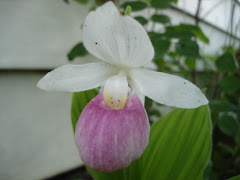
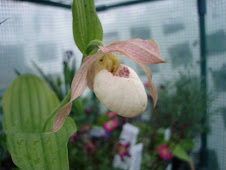
Here are the Cyps. pubescens and 'Emil' that I posted earlier. The 'Emil''s just finished flowering a few days ago, but the pubescens is still going; they have been in flower for about 2 weeks. The 'Emil' I think is much more attractive than the pubescens, though the flowers are only about half the size. I suppose the 'Emil' would have more competition against a more robust pubecens.
Saturday, June 07, 2008
Aquilegia scopulorum
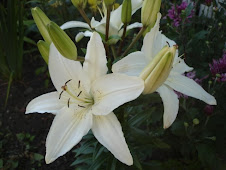
Lilium philadelphicum
Monday, May 26, 2008
My First Phrag Tetraploid Cross
Wednesday, May 21, 2008
Update on Cyp Hybrid Study
...And Yet More Blooms
Ramonda myconi is a very rare plant from the mountainous region of northern Spain. It is often called Pyrenean primrose, or simply Ramonda. Its pretty flowers remind me of shooting star (which is in the primrose family), but the two are not related. It is best grown on a slope or even vertically in rocky substrate, due to its very high susceptibility to crown rot. I just bought this plant the other day.
Lilium martagon is one of my favorite lily species. It has led to a wide selection of beautiful shade-tolerating lily hybrids called martagons.
Solomon's seal (Polygonatum multiflorum) is so-called because the cross-section of the roots looks like the seal of King Solomon. It is an awesome shade plant that will grow in FULL shade and forms clumps of graceful arching stems over time. The tiny green-tipped white flowers are very difficult to photograph. These will be followed by purple berries later in the summer.
This dwarf daffodil has been struggling to grow in a hot, sunny spot in my garden. Here is pictured the single, cute little flower it has produced.
Monday, May 19, 2008
More Spring Blooms
I have a very pretty clump of daffodils that have been in a shady bed in my garden since I was a little kid. They don't tend to bloom every year; more like every other year. I will never know why (maybe it is the shade) but when they do bloom they are very beautiful. This year the clump made 7 flowers for me.
This brooding black Iris is the darkest one I have ever seen. I just bought it a couple weeks ago. The first two flowers have opened, and as they are squished together, they just look like a mass of black petals. Hopefully I will get a better photo sometime.
Pulsatilla aurea is an alpine Pasqueflower species. The leaves are lacier and less-hairy than is typical, and it has greyish yellow, smaller flowers than other types. Quite a little novelty I think.
Many of the trees in my yard are flowering now, including this chokecherry, which a friend of the family gave us many years ago as a little cutting. Now it is a huge tree, at least 15 feet tall.
Finally we have Pulsatilla vulgaris, the most commonly-seen and grown Pasqueflower species. Its velvety purple flowers never fail to impress.
Meconopsis x sheldonii
Wednesday, May 14, 2008
Reptiles of the Garden
Arisaema sikokianum (top) is commonly known as dragon arum, dragonroot, Japanese Jack-in-the-pulpit, and snow rice-cake plant. It is likely the showiest of all the Arisaema species, shown here in its variegated form. The last two photos are of a wonderful Arisaema species that I just acquired today: A. kiushianum, or cobra lily. It is oone of the species with the long tongues - simply astounding.
Tuesday, May 13, 2008
A Study on Cypripedium Hybrids


Of late, Cyp hybrids have been all the rage with hardy orchid afficinados. According to the lucky Cyp growers who have had much experience with many of these hybrids, they are more robust, more vigorous, easier to grow and have larger flowers than the species. Over the next couple seasons I will do a direct comparison between Cyp. Emil (parviflorum x calceolus, top) and Cyp pubescens (bottom). Both had just one blooming size shoot last year and are growing next to each other. The Emil this year has four shoots, two blooming sized, while the pubescens has just one blooming size shoot, same as last year. I will update my readers on this weekly.
Dodecatheon 'Aphrodite' x meadia
Sunday, May 11, 2008
New Plants for the Season
Corydalis lutea (top) is the seldom-offered yellow corydalis species (the most common corydalis species are blue-flowered, and the popular C. solida is pink to red-flowered). It is quite different from more familiar corydalis varieties, with smoother-cut foliage resembling columbine leaves.
Sanguinaria canadensis f. multiplex (second) is the rare double form of the beautiful native woodland plant, bloodroot (S. canadensis), so named for the red-colored liquid contained within the roots. I find it rather resembles water lilies, and the foliage makes the plant attractive even when not in bloom. They bloom early in the spring.
Pulsatilla 'Papageno' (third) is actually not a new plant; it is in its second year now in my garden. A delightful Pasqueflower variety, it is the first plant to bloom in my garden this year.
The last photo depicts my favorite iris: Iris germanica 'Chivalry', which I have been eyeing at local greenhouses for a few years and I finally bought it last week. It has the most gorgeous shade of blue, and it produces up to 8 flowers per stem. The flowers are also very large and have a wonderful fragrance.
Wednesday, May 07, 2008
Coldframe Pleasures
The Cyp pubescens I have been posting about over the past few weeks has pretty much opened its flowers now (all of those Cyps are now in the coldframe). It is pictured in the first pic. The Arisaema sikokianum that has been accompanying the Cyps is also in the coldframe (second pic) and is almost totally opened. The next two photos are of a Cyp 'Gisela' that I just purchased today (not the one I have been picturing - it is darker and is still far from blooming). I very much like this variation and it is a very robust plant. the last photo is of a very uncommon Dodecatheon species, D. dentatum (dentate shooting star). The white-flowered species are always harder to get, and this one also has unique foliage and, as you can see, much shorter stems.
Sunday, May 04, 2008
Spring is Here - Finally...
...and I have been shopping! The bottom three photos show some of the plants I have bought so far, which are currently residing in the coldframe so they can be hardened off before I plant them. Pictured are Iris hookeri, Dicentra 'Candy Hearts', and a bunch of different plants in a group photo. Iris hookeri is sometimes regarded as a variety of the dwarf I. setosa. Dicentra 'Candy Hearts' is a great new variety that I almost like more than 'King of Hearts', my old favorite. In particular I bought a number of lilies, though they are not pictured.
The potted Cyps and Arisaema are outside now (at least during the day); pictured are Arisaema sikokianum (second photo) Cyp. parviflorum var. pubescens (third photo) and Cyp passerinum (top photo). The latter I just purchased a few days ago. It is in bud and I am very excited; these are difficlut to get.
Subscribe to:
Posts (Atom)