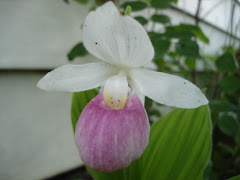
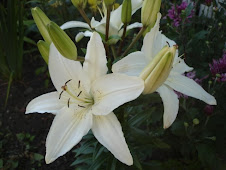
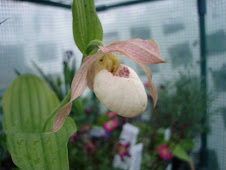
I am a little ticked because I bought 4 bulbs this spring that were supposed to be the white version of the little pink orchid I've posted before. However, they've turned out to be B. striata! Here is the first flower.
Tuesday, June 13, 2006
Bletilla striata var. abla? Not!
I am a little ticked because I bought 4 bulbs this spring that were supposed to be the white version of the little pink orchid I've posted before. However, they've turned out to be B. striata! Here is the first flower.


Bearded iris

Bearded iris are fantastic garden plants. These pictured here are in containers temporarily while the bed they grow in is renovated. They are the only bearded varieties I have, and I don't know what they are. The purple and white one
 has been in our garden for as long as I can remember and I don't know how they got there (there are many of them). They were in huge clumps that were very desperate for division; I divided them last year and this year they are responding amazingly; Iris usually take two seasons to bloom well again after dividing. The yellow and red-purple one I bought last year for very cheap at a garage sale and this year it is twice the size. Because I have such a limited selection of Iris I am striving to get more.
Iris sibirica
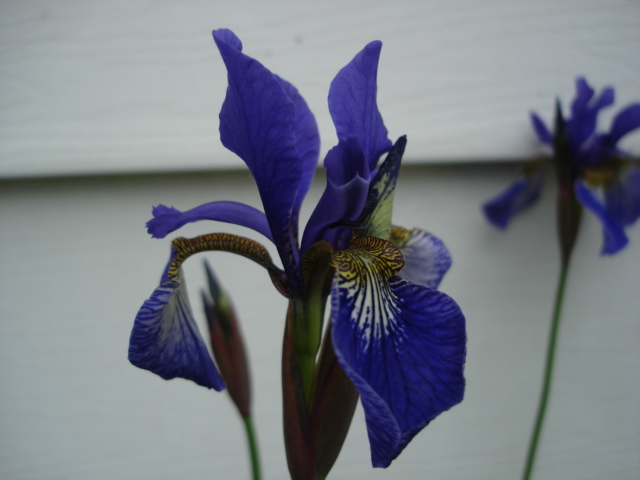

The original species of Siberian iris is in my opinion the most beautiful of that type. This beautiful plant was given to us many years ago by a friend of my grandma's who owns a botanical garden. I divided it a couple years ago; it is blooming profusely for the first time this year (it bloomed a LITTLE last year). The species forms attractive clumps that should be divided every 5 years or so to maintain vigour, and blooms in June with beautiful blue-violet flowers with silver and yellow marks. An established clump will produce 25 flowers or more. This one should make around 10-15 this year. This is my favorite iris species besides I. versicolor; I'm starting to really like I. setosa var. arctica, I. cristata, and I. reticulata. The species are way better than the hybrids, I think.
Friday, June 09, 2006
Slipper sizes
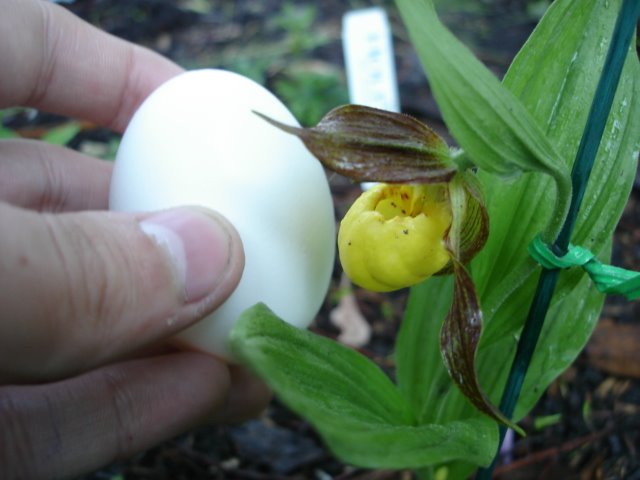
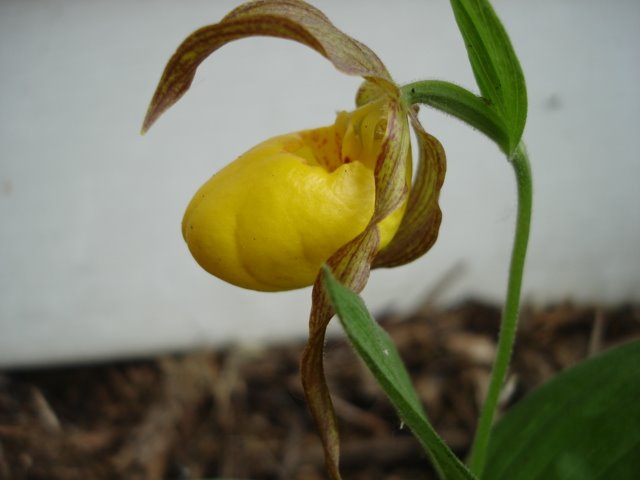
 Something really interesting about these guys is the difference in size between parviflorum and pubescens. A large egg was held right next to each flower. This is a young pubecens and its flower is already over twice the size of the fully mature parviflorum. Eventually the pubescens will be four times the size. Parviflorum is at the top and pubescens at the bottom.
Cypripedium parviflorum var. parviflorum
 The yellow lady's slippers are really awesome this year! This is the nicest parviflorum (small variety) I have ever had. I bought it a couple of weeks ago for $10 CAN at the horticultural society's perennial sale! A guy who has massive clumps of these has done some dividing this year. The pouch is the size of your thumbnail around.
Arisaema triphyllum

This is my favorite native aroid, aptly named Jack-in-the-pulpit. You can see the little green "guy" under the hood is Jack, in his pulpit. This flower comes in two forms; the other is purple with white stripes. I have it too.
Aquilegia vulgaris 'Nora Barlow'

This double columbine is sometimes called granny's bonnet. This photo is of an aged flower; I'll post a younger one soon.
Lilium orientalis mix
 Sometimes when you buy some lily bulbs you get a plant that is really advanced already, and when you plant it it grows about 6" tall and blooms. That happened to me this year. Here it is! A 4" flower is small for this type of lily, but it looks really cool on a 6" plant. The plant should grow normally next year.
Aquilegia x hybrida mix
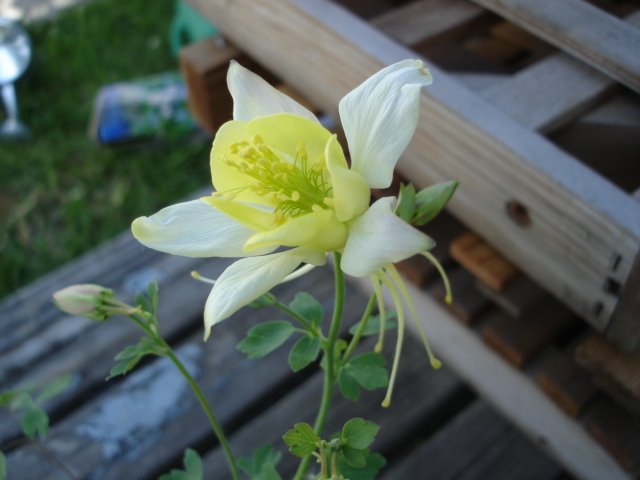 This plant is from my first-ever batch of columbine seeds, which I sowed three seasons ago. It is the first to bloom out of two plants that remain. It has a very large flower with a light scent.
Iris ensata 'Mt. Fuji'
 I am an Iris freak, and Japanese iris (Iris ensata) is my favorite type. They are unique in that their standards (upper petals) are very small, making the falls (lower ones) even more focal. They are also the most floriferous type of iris. This is one of my favorite varieties for its ice-white flowers. These guys like a wet acidic soil, the opposite of bearded iris, which must have a sharply-drained, alkaline soil.
Tuesday, June 06, 2006
OT Lily
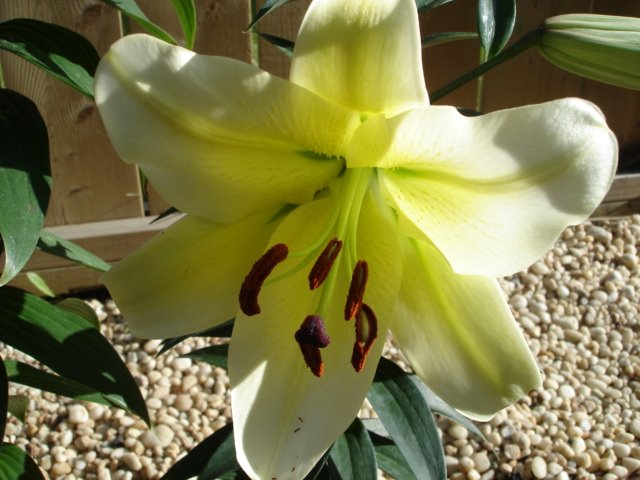 OT lilies are a cross between Oriental and trumpet lilies. With these, you get the best traits of each type: the fragrance and large size of Oriental lilies, and the trumpet shape of the trumpets. These have HUGE flowers with a great fragrance. I don't remember the cultivar name of this particular one.
Dicentra 'King of Hearts'

I am trying to figure out why I haven't posted a photo of this yet. This is THE best strain of Pacific bleeding heart there is; an award winner. Like their bigger cousins it is impossible to get a good photo of one. They form amazing mounds of grey-green ferny foliage and they bloom ALL spring and summer with stems of rosy-red flowers (unlike the old-fashioned types). They make for a great groundcover, reaching a foot in height and 2 in width.
Dicentra spectabilis

Old-fashioned bleeding heart is one of favorite perennials, and it's hard to take an aesthetically pleasing photo of one. This is my nicest one, which I bought last year because it was so huge. It's huge once again!
Anthemis 'White Carpet'
 Let's face it, I'm not a big fan of asters, except coneflowers. But this is definately a nice little groundcover Margeurite daisy, and you can see why it is named "Snow Carpet". This photo was taken a few days ago before it really started blooming; if I get the time after I post all these updates I'll take another photo.
Aquilegia alpina
 I should really call this "unknown columbine" because although its flowers look like those of Aquilegia alpina (alpine columbine), the plant grows to 18" tall and has huge leaves. A. alpina would be (should be!) no more than 8" tall (probably 6) AND the leaves and flowers would be smaller. Nonetheless, until I find a better name, that's the one I'm keeping.
Sunday, June 04, 2006
Dodecatheon meadia
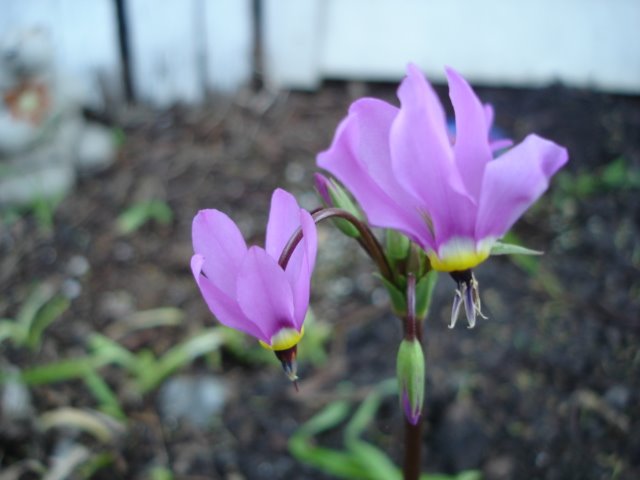 Dodecatheon meadia (shooting star) is another one of my favorite perennials, a member of the primrose family. It is relatively unknown as a garden plant but gaining popularity, and some people recognize it as a wildflower. D. pulchellum (saline or few-flowered shooting star) is a native of my area. I own one but it is too young to bloom right now. This one pictured here has grown in to an impressive clump. I planted it three seasons ago (spring 2004) as a double-nosed plant with one stem; today it has six shoots and four stems (time to divide). These are vigorous plants that are fairly easy to grow. I find that they dry out too rapidly in the sun and wilt (tags usually say full sun) so I grow them in partial shade. They will take infinite amounts of water in a well-drained soil and perform best when fertilized with other perennials. They lose vigour after 3 or 4 years and will need division. It is called shooting star because of its nodding, star-shaped flowers, which are borne in clusters on stalks 12-16" tall. They make excellent companions for lady's slippers and look best with yellow ones.
Tons of Updates Coming!
To all my loyal web site viewers (lol!),
I haven't posted anything for the past (over a) week because I've been very busy with school, but I have taken a lot of garden photos, and it's time to post 'em, so get ready!
I haven't posted anything for the past (over a) week because I've been very busy with school, but I have taken a lot of garden photos, and it's time to post 'em, so get ready!
Sunday, May 28, 2006

Monday, May 22, 2006
Cypripedium parviflorum var. pubescens
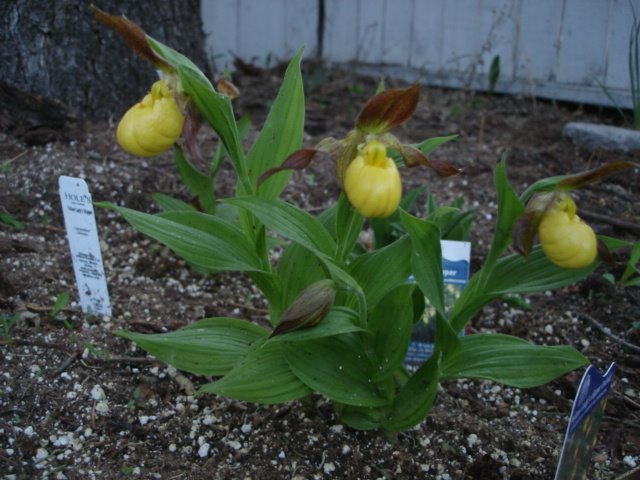
My new pubescens from last weekend. It started blooming a couple days ago. The fourth flower is just opening now. This is the nicest cyp I've ever bought in its first year. When it comes to pubescens, every plant is different (usually) as they are extremely variable. It can be fun to collect the different forms. Every plant I have is different. This one has nice rich brown-colored tepals. I have another that has not bloomed yet and will not until next year. Another has smaller (but not parviflorum) flowers and the pouch is shaped somewhat like C. kentuckiense (a southern relative) and with deep maroon tepals. It is taking a bloom break this year. Another is the "standard" form, with large flowers that have greenish-yellow tepals with a moderate amount of rusty-brown coloring. It will bloom in a week or so.
Subscribe to:
Posts (Atom)