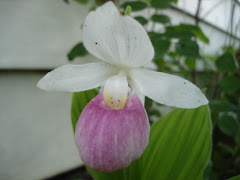
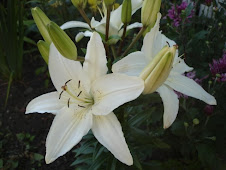
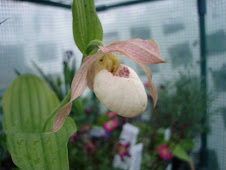
Slipper orchids have got to be on the top ten list of the most fascinating plants in the world. They are so unique that some botanists believe that they should be separated into their own family. Besides that, intergenerically there is an astounding amount of variation; you can plainly see that in the slipper orchid photos I have posted on this blog so far this year, including Paphiopedilum insigne, Phragmipedium besseae, Phragmipedium Ecuabess, Paphiopedilum Maudiae (& other paphs), and Cypripedium parviflorum. Cypripediums are my favorites; Cypripedium acaule was what got me obsessed with botany while researching Prince Edward Island (a Canadian province whose floral emblem is C. acaule) for a Grade 6 school project. Within the so-called Slipper Alliance are five genera: Phragmipedium, Paphiopedilum, Selenipedium, Mexipedium and Cypripedium, which were once all classified under Cypripedium but were reclassified due to extreme variation. The name Cypripedium comes from Cyprus, another name for Venus, and the Greek pedilon (foot), referring to the shape of the inflated lip (pouch) of every species. The other names all mean basically the same thing, in a different context. The reasoning for the common name lady's slipper or mocassin-flower is obvious at first glance of any flower.
The very first slipper orchid ever discovered was Cypripedium calceolus of Europe (later also discovered in Asia). This beautiful orchid has handsome yellow pouches and maroon tepals (word for sepals and petals that are very similar). In later expeditions in North America, similar species were discovered which were given the same name; these are C. parviflorum varieties; the name was recently changed after the realization of many differences between the species and genetic proof that they are separate. The old name of these N. American natives, however, still sticks. Anyway, C. calceolus was discovered sometime between 1450 and 1500 (probably before then by the Asians); at this time a major "orchid craze" was erupting in Europe after the discovery of unusual but beautiful plants deemed "orchids" (from orchis, the Greek meaning testicles, referring to the arrangement of the ovaries) in Central and South America. European explorers, especially British, French, Italians, Dutch, and Germans, went on many major expeditions over the next 400 years, bringing back these plants for the growing market. many areas, especially the Amazon, were depleted of native orchid species, including Phragmipedium. When North America was settled, settlers quickly discovered the abundance of terrestrial orchids in that area, and picked them and transplanted them to their gardens. Most of these were Cypripediums, the showiest of terestrial orchids. Meanwhile in Europe, epiphytic (grow on trees) and some native terrestrial orchids were purchased for huge sums of money, only to die in the new owner's garden. The same happened the the orchids in North America. But smuggling continued, and with no way to propagate the plants, they quickly disappeared, many almost to extinction; in England, even today, only a single plant of C. calceolus remains. Today, however, scientists use artificial propagation to raise plants from seed and tissue culture, and orchids can be found for under $20 at your local Home Depot. With their bad reputation for being impossible to grow though, terrestrial orchids, mainly Cypripediums, are just beginning to gain poularity. With the protection of wild plants by law and the increased availability of nursery raised plants, Cyps are slowly recuperating.
Cyps are slow to establish in the garden, and one will quickly fall to the orchid fever when viewing wild plants. Having been there for who knows how long, wild cyps often display themselves in fantastic clumps or colonies with hundreds or thousands of flowers. Last year I had the great pleasure of visiting a local natural area, where yellow slippers are known to exist in amazing numbers. Another great thing I noticed while viewing them is their size, being very mature plants. If you buy a blooming plant at a local nursery, it is usually flowering for the first time, and flowers are small, with dull colors. A mature plant puts on a show a hundred times better. Cyp pubescens is the most common of all hardy orchids, both in the garden and on the market. I've seen these a hundred billion times, and yet, each time I do, my soul is captured. Many others share my feeling.
Friday, May 19, 2006


Sisyrinchium 'California Skies'

This is an excellent hybrid of blue-eyed grass, an iris relative that goes underused in the garden. Mound of grass-like foliage are contrasted by bright blue to violet star-shaped flowers with a yellow eye in early summer. A great plant for relatively dry, sunny or partially shaded areas or a rock garden. Most hybrids and the species S. montanum are hardy to zone 2 or 3; S. idahoense is more tender.
Wednesday, May 17, 2006
Tuesday, May 16, 2006
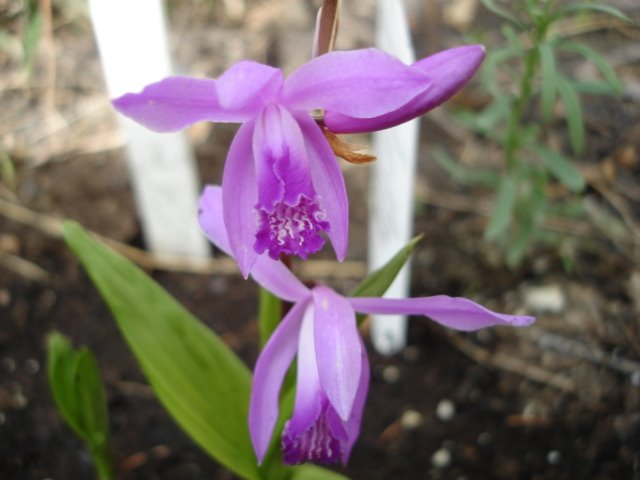
Bletilla striata

The hyacinth orchid (more commonly called the Chinese ground orchid) is perhaps the easiest of all hardy orchids to grow... though it isn't really hardy in my region! These are hardy to zone 5; I live in zone 3 but people in my area have grown them successfully against the house like a clematis; if it gets really cold though (like -40 C as it sometimes does), the plant is screwed either way so I just dig them up and store them in the fridge in little bags over the winter. Unfortunately, they never naturalize or get very big this way, so I mass plant. This is the first to bloom in my garden. You can see my thumb for scale - you can hardly notice the tiny flowers in the garden unless you do mass plant. Up close they are very beautiful. the great thing about my climate is that I can plant these in full sun usually without scorching the leaves if they are well-watered. (I write this as it is 30 C/86 F outside right now!) I also have var. alba which has pure white flowers, though slower growing than the original.
Monday, May 15, 2006
Primroses 1

 Primroses are excellent shade plants, provided you have the right kind. The primroses here are both auricula types; the yellow one is the species Primula auricula.
Sunday, May 14, 2006
Yet Another Cyp pubescens!
 This weekend I bought yet another large yellow l.s. This is the nicest cyp I've ever bought; these shoots are HUGE, around 1/3" or even 1/2"in diameter at the base. They are just opening now. This plant will produce four 4" blossoms on five shoots and should reach maximum height and leafspan. It cost me $40 and has awesome roots that were all tangeled and overcrowded in the 4.5" pot.
Friday, May 12, 2006
Cypripedium acaule

The pink or stemless lady's slipper is considered by many to be the most difficult to grow of the lady's slippers in cultivation. I've had a bit of a hard time; last year it had 4 shoots and 3 flowers (bought it last year) and this year it was going to have 4 shoots but one rotted off. The others look awesome and I'm pretty proud of myself for my accomplishment here. It's growing in 60% shade under a tree. The trick with these guys is to grow in a VERY VERY acidic soil, pH 3-4.5, or the plant will die in a couple seasons. I water with RO water mixed with vinegar at a dilution of 2 tbsp. vinegar per 1 gallon water. When you see weeds growing around the plant, you know it's time for some more vinegar! Never fertilize and try to water only seldom. Also, I think my shoot might've rotted off from late winter/early spring wet, so grow in a gritty soil and plant raised above ground level. This plant has a very long root sytem unlike the yellows and therefore it is very easy to break the roots when moving (which is not good) so don't move if at all possible. Who ever is reading this, wish me luck this year!
Cypripedium parviflorum var. pubescens

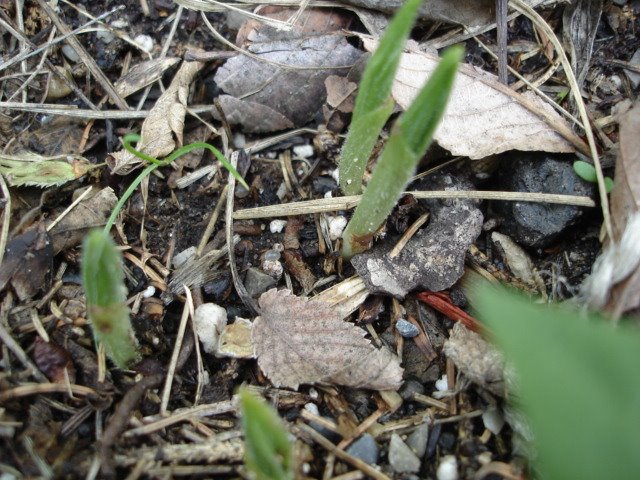

Here are my three large yellow lady's slippers. These are the larger form of the one I posted a couple weeks ago, growing to 16" tall and with flowers up to 4" across. They are by far the easiest of the lady's slipper species to grow and the most vigorous, and I find them awesome garden plants. These are just beginning to leaf out now, as they always do in my area. The single-shooted one I bought last year; it is (was) much larger than the others at 16" tall and with a 4" flower, but doesen't seem to want to multiply just yet. It is growing in 70% shade in my shady border. The quad-shooted one was my very first successful lady's slipper, in its third year in my garden. It started out in 2004 with two shoots and one flower. Last year it had 4 shoots and three flowers. This year looks about the same. It's growing in half shade under a tree. The many-shooted one has nine shoots. I bought it last fall at a plant sale completely dormant; I checked it out to make sure it was healthy and bought it; I got it for $20 reg. $40! It looked like it had 4 or 5 shoots last year and should bloom for the first time this year (it might've bloomed last year; it was hard to tell). It's growing with my new parviflorum under a spruce tree in half shade. I'm guessing 3-5 flowers.
Wednesday, May 10, 2006
Iris pallida 'Aureo Variegata'

Here is a nicer pic of the Iris I bought last weekend, now in my coldframe.
More bloomers

 The top pic shows Bergenia cordifolia, an excellent groundcover for the shady border or rock garden with glossy, leathery leaves which are dark green in the summer and deep wine-red in the fall and winter, and small clusters of magenta flowers in the early spring. This is a young plant which I planted last year. The bottom pic shows Aquilegia 'Winky Blue & White', a nice garden hybrid columbine. They usually bloom starting in the end of May and into June and even July here; I bought this plant early and so it is blooming early.
Pulsatilla vulgaris
 Pasqueflower - as I mentioned before - is an awesome early spring bloomer for the rock garden. Here's the standard form - this pic was taken last week.
Early Spring Shopping 4

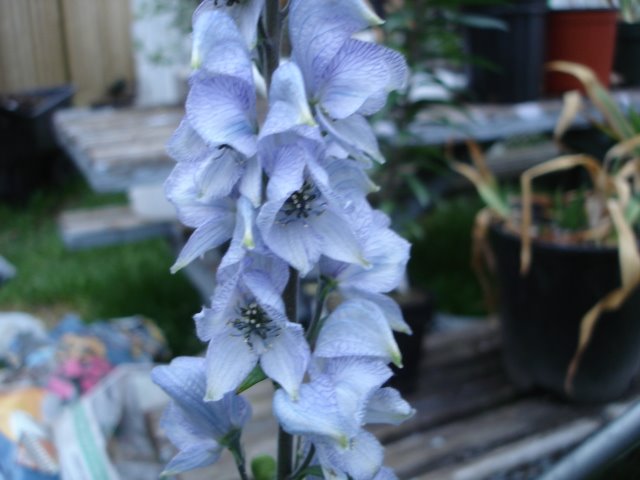 More pics of plants I purchased lats weekend. On the top - Trillium erectum. It goes by many names, including red trillium, purple trillium, red or purple wake-robin, trinity flower, birthroot, stinking benjamin and many more. The last name is from a wet dog-like scent in the flower which is actually very mild. On the bottom, something a little more recognizable: Aconitum 'Stainless Steel', my favorite monkshood which I have lusted for for a long while.
Saturday, May 06, 2006
Early Spring Shopping 3
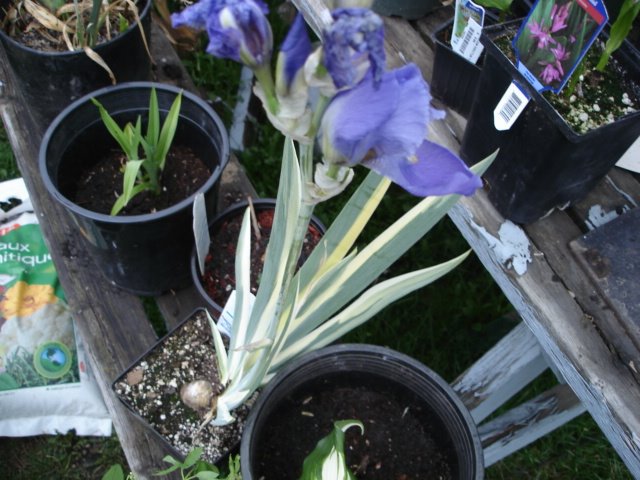

Here we have Iris pallida 'Aureo Variegata' (Variegated Sweet Iris Gold Form) - top and Cornus canadensis (Bunchberry). Bunchberry is a native North American woodland plant related to the popular dogwood trees, with creamy-white flowers, and this strain of Iris, as you can see, has beautiful gold-striped foliage and light-lavender fragrant flowers.
Early Spring Shopping 2

This is Hosta 'Medium Variegata', a truly striking foliage plant for the shady border.
Early Spring Shopping 1

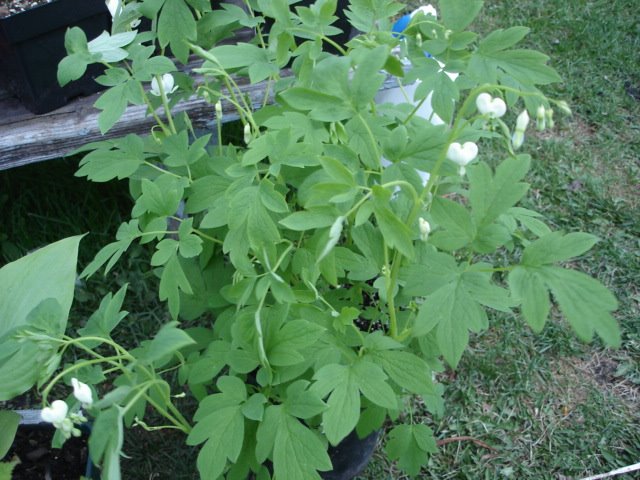
This weekend I am doing some early spring perennial shopping. In my area most gardeners consider it a sin to buy anything before the Victoria Day long weekend at the end of the month because the weather is so unpredictable up to that point but people don't realize how hardy most perennials really are and I daresay are ridiculously scared and even anal-retentive about the whole thing; the truth is that unless you have something rated hardy to 2 zones above yours or more (plants that you dig up in the fall), it is possible to harden them off and plant them right after last frost (May 7 here). And I have proof: I've done this the past 3 years and not one of these plants has died or suffered injury. Anyway, this first plant is a HUGE white bleeding heart (Dicentra spectabilis var. alba) which I am going to use as an edger in a shady border.
Thursday, May 04, 2006
Gentiana acaulis
 The trumpet or stemless gentian is my favorite gentian for its gorgeous sky-blue flowers rivaled only by the blue Himalayan poppy, Meconopsis grandis, and a couple other Gentiana species. It is my favorite gentian not only for its flowers but also its hardiness and low, spreading growth habit; as well, it is one of the easier gentians to grow.
Monday, May 01, 2006
New Style!
Today I decided to change the style (template) of this blog for a fresh new look. It seems to go with the blog's purpose more as well.
Pulsatilla vulgaris var. rubra
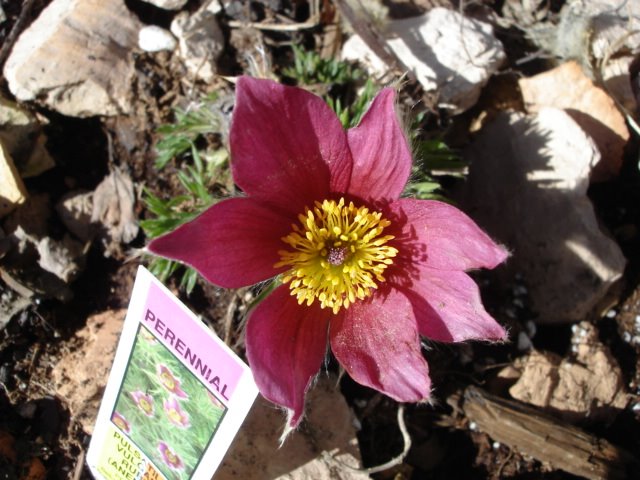
Pasqueflower is an awesome spring flower and rock garden plant; they come in a few different colors and this is the red variety. These small plants have fuzzy, ferny foliage and they bloom before it matures, so you have the appearance of a small plant about 2" tall and 3" wide with large 2" blooms! A species native to cold areas similar to where I live is Pulsatilla patens or prairie crocus, which blooms with lavender flowers before the snow melts. I plan to add that plant to my rock garden this year. In addition to the plant pictured here I have Pulsatilla vulgaris which has deep purple to maroon flowers; it appears that it will bloom this week.
Friday, April 28, 2006
Arisaema sikokianum

This is my favorite aroid (plant whose flower is protected by a decorative spathe), and it goes by many names, including dragonroot, dragon arum, and Japanese Jack-in-the-pulpit. If you live in North America, you've probably seen or heard of Jack-in-the-pulpit (Arisaema triphyllum), which is native to northeastern sections of the continent; A.sikokianum is a much more showy relative. Despite the fact that it is native to Asia, it is hardy to zone 4 and can be grown here in zone 3 with some winter protection. This one will also remain in the coldframe with my new lady's slipper until it warms up a bit (it's around 20-25 C in the day right now but still 0-5 C in the night).
Cypripedium parviflorum var. parviflorum

This is the small yellow lady's slipper, one of the grandest of all wildflowers, a North American native orchid. This little beauty is only 6" tall and the flower is about 2.5" across. It has a pleasant, rosy fragrance. Best of all, it's easy to grow in the garden, provided you have a quality, nursery-grown plant that is not wild-collected. Later in the year I'll post complete culture guidlines on my three most highly recommended lady's slipper species and hybrids for the temperate gardener, as well as a list of quality sources in Canada, the US, and the UK. This particular plant is not my first parviflorum; I spotted it at my local source yesterday and I just can't resist the temptation. It cost me $25 CAN! For now, it will remain in my coldframe until last frost (May 7 in my area).
Subscribe to:
Posts (Atom)