Friday, June 09, 2006

Slipper sizes


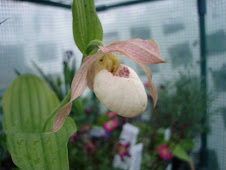
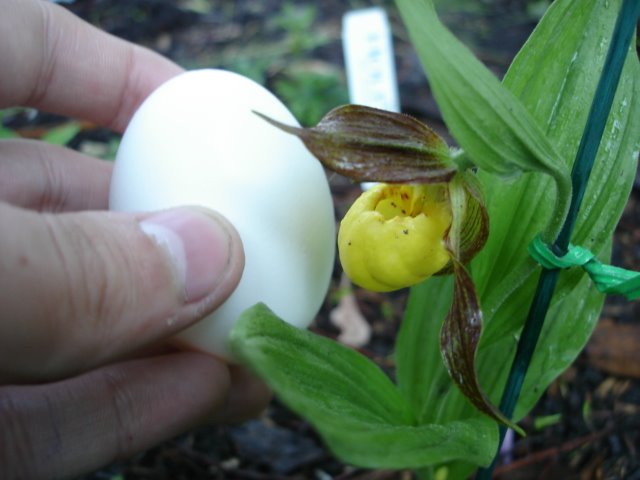
Something really interesting about these guys is the difference in size between parviflorum and pubescens. A large egg was held right next to each flower. This is a young pubecens and its flower is already over twice the size of the fully mature parviflorum. Eventually the pubescens will be four times the size. Parviflorum is at the top and pubescens at the bottom.

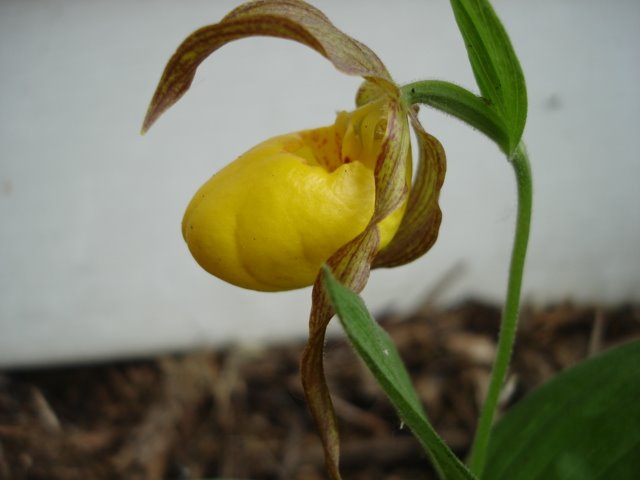
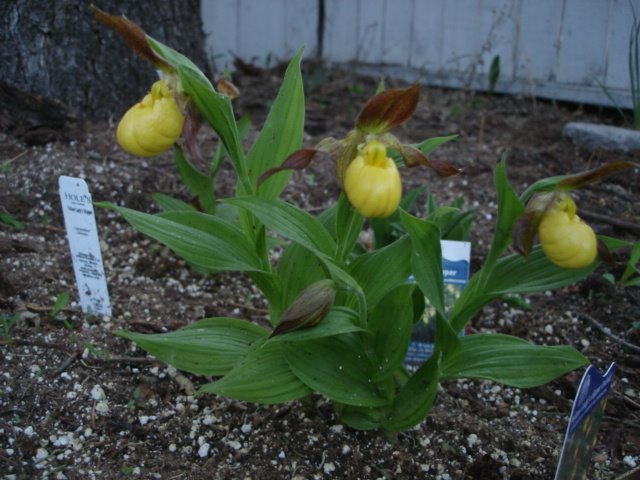
Cypripedium parviflorum var. parviflorum

The yellow lady's slippers are really awesome this year! This is the nicest parviflorum (small variety) I have ever had. I bought it a couple of weeks ago for $10 CAN at the horticultural society's perennial sale! A guy who has massive clumps of these has done some dividing this year. The pouch is the size of your thumbnail around.

Arisaema triphyllum


This is my favorite native aroid, aptly named Jack-in-the-pulpit. You can see the little green "guy" under the hood is Jack, in his pulpit. This flower comes in two forms; the other is purple with white stripes. I have it too.

Aquilegia vulgaris 'Nora Barlow'


This double columbine is sometimes called granny's bonnet. This photo is of an aged flower; I'll post a younger one soon.

Lilium orientalis mix

Sometimes when you buy some lily bulbs you get a plant that is really advanced already, and when you plant it it grows about 6" tall and blooms. That happened to me this year. Here it is! A 4" flower is small for this type of lily, but it looks really cool on a 6" plant. The plant should grow normally next year.

Aquilegia x hybrida mix

This plant is from my first-ever batch of columbine seeds, which I sowed three seasons ago. It is the first to bloom out of two plants that remain. It has a very large flower with a light scent.

Iris ensata 'Mt. Fuji'

I am an Iris freak, and Japanese iris (Iris ensata) is my favorite type. They are unique in that their standards (upper petals) are very small, making the falls (lower ones) even more focal. They are also the most floriferous type of iris. This is one of my favorite varieties for its ice-white flowers. These guys like a wet acidic soil, the opposite of bearded iris, which must have a sharply-drained, alkaline soil.

Tuesday, June 06, 2006

Cypripedium pubescens

Another one of my yellow "ladies" is blooming.

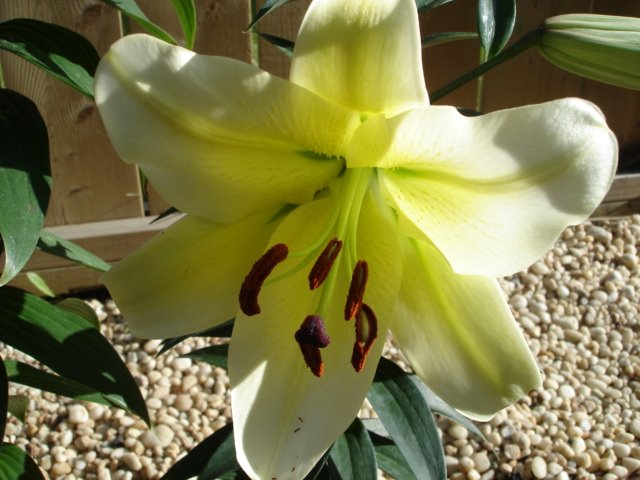
OT Lily

OT lilies are a cross between Oriental and trumpet lilies. With these, you get the best traits of each type: the fragrance and large size of Oriental lilies, and the trumpet shape of the trumpets. These have HUGE flowers with a great fragrance. I don't remember the cultivar name of this particular one.

Dicentra 'King of Hearts'


I am trying to figure out why I haven't posted a photo of this yet. This is THE best strain of Pacific bleeding heart there is; an award winner. Like their bigger cousins it is impossible to get a good photo of one. They form amazing mounds of grey-green ferny foliage and they bloom ALL spring and summer with stems of rosy-red flowers (unlike the old-fashioned types). They make for a great groundcover, reaching a foot in height and 2 in width.

Dicentra spectabilis


Old-fashioned bleeding heart is one of favorite perennials, and it's hard to take an aesthetically pleasing photo of one. This is my nicest one, which I bought last year because it was so huge. It's huge once again!

Anthemis 'White Carpet'

Let's face it, I'm not a big fan of asters, except coneflowers. But this is definately a nice little groundcover Margeurite daisy, and you can see why it is named "Snow Carpet". This photo was taken a few days ago before it really started blooming; if I get the time after I post all these updates I'll take another photo.

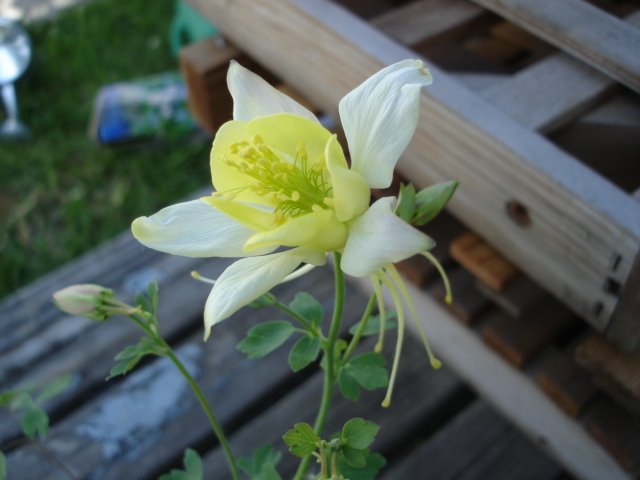
Aquilegia alpina

I should really call this "unknown columbine" because although its flowers look like those of Aquilegia alpina (alpine columbine), the plant grows to 18" tall and has huge leaves. A. alpina would be (should be!) no more than 8" tall (probably 6) AND the leaves and flowers would be smaller. Nonetheless, until I find a better name, that's the one I'm keeping.

Sunday, June 04, 2006

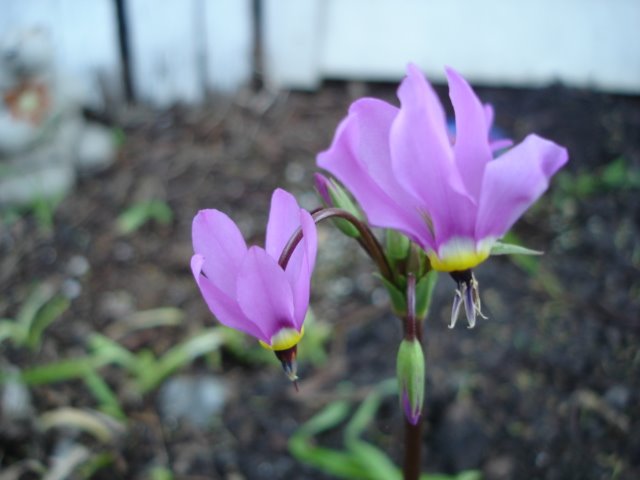
Dodecatheon meadia

Dodecatheon meadia (shooting star) is another one of my favorite perennials, a member of the primrose family. It is relatively unknown as a garden plant but gaining popularity, and some people recognize it as a wildflower. D. pulchellum (saline or few-flowered shooting star) is a native of my area. I own one but it is too young to bloom right now. This one pictured here has grown in to an impressive clump. I planted it three seasons ago (spring 2004) as a double-nosed plant with one stem; today it has six shoots and four stems (time to divide). These are vigorous plants that are fairly easy to grow. I find that they dry out too rapidly in the sun and wilt (tags usually say full sun) so I grow them in partial shade. They will take infinite amounts of water in a well-drained soil and perform best when fertilized with other perennials. They lose vigour after 3 or 4 years and will need division. It is called shooting star because of its nodding, star-shaped flowers, which are borne in clusters on stalks 12-16" tall. They make excellent companions for lady's slippers and look best with yellow ones.

Tons of Updates Coming!

To all my loyal web site viewers (lol!),

I haven't posted anything for the past (over a) week because I've been very busy with school, but I have taken a lot of garden photos, and it's time to post 'em, so get ready!

Sunday, May 28, 2006

New Cyp pubescens... again


Here is my new cyp pubescens with all the flowers open.

Monday, May 22, 2006

Cypripedium parviflorum var. pubescens


My new pubescens from last weekend. It started blooming a couple days ago. The fourth flower is just opening now. This is the nicest cyp I've ever bought in its first year. When it comes to pubescens, every plant is different (usually) as they are extremely variable. It can be fun to collect the different forms. Every plant I have is different. This one has nice rich brown-colored tepals. I have another that has not bloomed yet and will not until next year. Another has smaller (but not parviflorum) flowers and the pouch is shaped somewhat like C. kentuckiense (a southern relative) and with deep maroon tepals. It is taking a bloom break this year. Another is the "standard" form, with large flowers that have greenish-yellow tepals with a moderate amount of rusty-brown coloring. It will bloom in a week or so.

Friday, May 19, 2006

The Story of Cypripedium

Slipper orchids have got to be on the top ten list of the most fascinating plants in the world. They are so unique that some botanists believe that they should be separated into their own family. Besides that, intergenerically there is an astounding amount of variation; you can plainly see that in the slipper orchid photos I have posted on this blog so far this year, including Paphiopedilum insigne, Phragmipedium besseae, Phragmipedium Ecuabess, Paphiopedilum Maudiae (& other paphs), and Cypripedium parviflorum. Cypripediums are my favorites; Cypripedium acaule was what got me obsessed with botany while researching Prince Edward Island (a Canadian province whose floral emblem is C. acaule) for a Grade 6 school project. Within the so-called Slipper Alliance are five genera: Phragmipedium, Paphiopedilum, Selenipedium, Mexipedium and Cypripedium, which were once all classified under Cypripedium but were reclassified due to extreme variation. The name Cypripedium comes from Cyprus, another name for Venus, and the Greek pedilon (foot), referring to the shape of the inflated lip (pouch) of every species. The other names all mean basically the same thing, in a different context. The reasoning for the common name lady's slipper or mocassin-flower is obvious at first glance of any flower.

The very first slipper orchid ever discovered was Cypripedium calceolus of Europe (later also discovered in Asia). This beautiful orchid has handsome yellow pouches and maroon tepals (word for sepals and petals that are very similar). In later expeditions in North America, similar species were discovered which were given the same name; these are C. parviflorum varieties; the name was recently changed after the realization of many differences between the species and genetic proof that they are separate. The old name of these N. American natives, however, still sticks. Anyway, C. calceolus was discovered sometime between 1450 and 1500 (probably before then by the Asians); at this time a major "orchid craze" was erupting in Europe after the discovery of unusual but beautiful plants deemed "orchids" (from orchis, the Greek meaning testicles, referring to the arrangement of the ovaries) in Central and South America. European explorers, especially British, French, Italians, Dutch, and Germans, went on many major expeditions over the next 400 years, bringing back these plants for the growing market. many areas, especially the Amazon, were depleted of native orchid species, including Phragmipedium. When North America was settled, settlers quickly discovered the abundance of terrestrial orchids in that area, and picked them and transplanted them to their gardens. Most of these were Cypripediums, the showiest of terestrial orchids. Meanwhile in Europe, epiphytic (grow on trees) and some native terrestrial orchids were purchased for huge sums of money, only to die in the new owner's garden. The same happened the the orchids in North America. But smuggling continued, and with no way to propagate the plants, they quickly disappeared, many almost to extinction; in England, even today, only a single plant of C. calceolus remains. Today, however, scientists use artificial propagation to raise plants from seed and tissue culture, and orchids can be found for under $20 at your local Home Depot. With their bad reputation for being impossible to grow though, terrestrial orchids, mainly Cypripediums, are just beginning to gain poularity. With the protection of wild plants by law and the increased availability of nursery raised plants, Cyps are slowly recuperating.

Cyps are slow to establish in the garden, and one will quickly fall to the orchid fever when viewing wild plants. Having been there for who knows how long, wild cyps often display themselves in fantastic clumps or colonies with hundreds or thousands of flowers. Last year I had the great pleasure of visiting a local natural area, where yellow slippers are known to exist in amazing numbers. Another great thing I noticed while viewing them is their size, being very mature plants. If you buy a blooming plant at a local nursery, it is usually flowering for the first time, and flowers are small, with dull colors. A mature plant puts on a show a hundred times better. Cyp pubescens is the most common of all hardy orchids, both in the garden and on the market. I've seen these a hundred billion times, and yet, each time I do, my soul is captured. Many others share my feeling.
Sisyrinchium 'California Skies'


This is an excellent hybrid of blue-eyed grass, an iris relative that goes underused in the garden. Mound of grass-like foliage are contrasted by bright blue to violet star-shaped flowers with a yellow eye in early summer. A great plant for relatively dry, sunny or partially shaded areas or a rock garden. Most hybrids and the species S. montanum are hardy to zone 2 or 3; S. idahoense is more tender.

Wednesday, May 17, 2006

2 more to go...

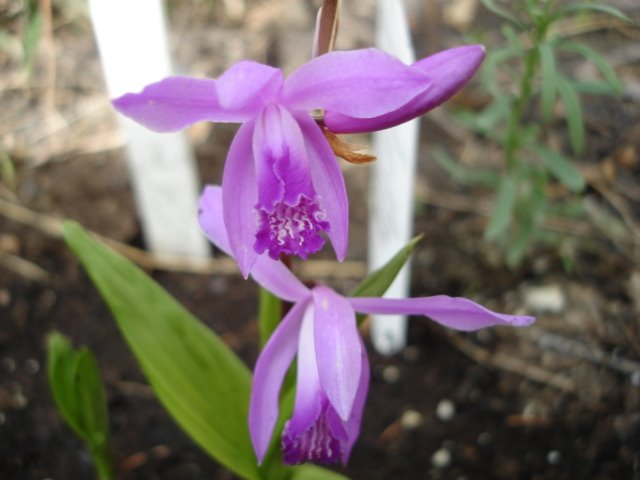
The second flower on my little hyacinth orchid opened today.