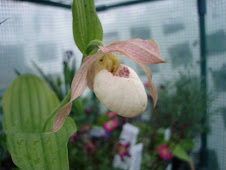
Ah, fall has arrived (basically), and so begins the Paph season, starting with complex hybrids. This is only one of 2 that I own, and is a recent acquisition. The FCC/AOS in the name means that the first parent, Winston Churchill 'Indomitable' won the First Class Certificate from the American Orchid Society - the most prestigous award available from the largest orchid society in the world. Therefore this grex can be expected to be one heck of a nice plant, and I am very pleased with the turnout. It's a variable cross, and this one has tended towards the first parent (for the most part).
Friday, August 31, 2007
Sunday, August 26, 2007
Nepenthes copelandii
I started out with a single Venus fly trap a few years ago; it died, and I tried another, which also died. However, my third try has been a success, and now I have a little carnivorous plant collection going on. These plants are not easy to grow; I've had more trouble with them than orchids, but with a little research and extra effort, the results are very exciting. I've found that a terrarium is an imperative investment. A standard 10 to 20-gallon aquarium works really well for a small collection. The terrarium creates a microclimate that the plants can grow in. In this microclimate, humidity is high, between 70 and 100%, and temperatures aere warm. I place it in near-direct sun outside during the summer. Of course, the carnivores I grow in it (Dionaea, VFT; and Sarracenia, American pitcher plant), are temperate plants and require a cold winter dormancy, so they must be taken out of the terrarium and placed in the crisper drawer of a refrigerator from November to March. They are then replaced in the terrarium. The terrarium is kept inside when frosts are frequent outside.
And now, to the point of this post. The beautiful plant pictured above is Nepenthes copelandii, or tropical pitcher plant, or monkey cups. It is just one out of I believe around 40 or 50 species of carnivorous plants native to southeast Asia. These are vines that grow in dense rainforest, climbing up trees. They can climb to a great length over time. The leaves form long tendrils that end in pitcher-like adaptations which can boast brilliant color patterns and produce a sweet scent. Both of these features attract insects, which will land on the opening/rim of the pitcher and, in trying to discover the source of the scent, will slip on the glossy surface and fall into the pitcher. There they will land in a pool of putrid liquid and will find escape is impossible due to downward-pointing hairs on the walls of the pitcher. After trying hopelessly to escape, the insect will eventually tire and drown. The pitcher will then secrete enzymes which will digest the insect, and over time the walls of the pitcher will absorb the nutrients in the liquid. This is how the plant receives its nourishment, as it grows where nutrients do not exist in the rooting medium. Many of these plants do not even have roots, as they absorb nutrients through the pitchers and moisture from the air through the leaves. Nepenthes also produce sprays of small flowers.
Nepenthes are fantasic plants which are unusual, attractive, and help eliminate pest problems. They are tropical, and so don't require a winter dormancy period. However, they require high humidity, and are too large to grow in terraria (unless you have a massive aquarium), and so can be accommodated only in a glass case (such as an orchidarium) or in a greenhouse. I use the former.
Nepenthes copelandii is one of two Nepenthes species I own; the other is N. alata.
Saturday, August 18, 2007
It's Been a Long Time...
Since my last post. It turns out I've been really busy lately. However, as fall approaches things in the garden are slowing down, and I can settle down and concentrate on my favorite group of plants - orchids! I have some photos of new plants and of lilies, which I will post in the near future. I also have some now-outdated orchid pics to post. For now, here is a photo of one of my newest orchid purchases, Paph Pinocchio, a hybrid of subgenus Cochlopetalum. This is a very beautiful specimen with three large growths. It is part of a large haul I just brought back from Paramount Orchids, which includes 10 Paphs and a Phrag. I need to update my most-wanted orchid listings, as they are now outdated! This was my most expensive and perhaps most important haul ever, as it includes some very important and rare crosses. They are (not including Pinocchio):
Paph Magic Lantern, a must-have classic Parvi hybrid
Paph Joyce Hasegawa, a fantastic, well-known Parvi hybrid, part of a set of three Hasegawa hybrids
Paph Ho Chi Minh x vietnamense, a new, unnamed back-cross of this unbeatable hybrid into the most striking Parvi species
Paph Fanaticum, a naturally-occuring hybrid that was also artificially created between two large-flowering Parvi species
Paph Winston Churchill 'Indomitable' FCC/AOS x gratrixianum, a complex cross between an antique hybrid boasting the grandest ribbon attainable and a nice compact species
Paph delenatii 'Mighty Fragrant' x self, a selfing of a newer clone of this wonderful Parvi species bred for fragrance (seedling).
Paph Wossner Butterfly, one of the brand new primary Parvi hybrids made with Paph vietnamense
Phrag Eric Young, one of the first of the long line of besseae hybrids made after its discovery; a classic
Oncidium Twinkle 'Red Fantasy', a fantastic miniature, chocolate-scented Oncidium
Miltoniopsis Newton Falls, a really nice pink with darker waterfall mask and white markings
I also managed to get some compots of some rare Paph species over the summer from Forestview Gardens: Paph malipoense, micranthum (coming next month) and spicerianum (3 in each). Also, I am now adding a new feature to my blog: a list of plants (orchids - I have too many perennials to do that with) currently in spike/bud/bloom. That's just how freaky I am.
Paph Magic Lantern, a must-have classic Parvi hybrid
Paph Joyce Hasegawa, a fantastic, well-known Parvi hybrid, part of a set of three Hasegawa hybrids
Paph Ho Chi Minh x vietnamense, a new, unnamed back-cross of this unbeatable hybrid into the most striking Parvi species
Paph Fanaticum, a naturally-occuring hybrid that was also artificially created between two large-flowering Parvi species
Paph Winston Churchill 'Indomitable' FCC/AOS x gratrixianum, a complex cross between an antique hybrid boasting the grandest ribbon attainable and a nice compact species
Paph delenatii 'Mighty Fragrant' x self, a selfing of a newer clone of this wonderful Parvi species bred for fragrance (seedling).
Paph Wossner Butterfly, one of the brand new primary Parvi hybrids made with Paph vietnamense
Phrag Eric Young, one of the first of the long line of besseae hybrids made after its discovery; a classic
Oncidium Twinkle 'Red Fantasy', a fantastic miniature, chocolate-scented Oncidium
Miltoniopsis Newton Falls, a really nice pink with darker waterfall mask and white markings
I also managed to get some compots of some rare Paph species over the summer from Forestview Gardens: Paph malipoense, micranthum (coming next month) and spicerianum (3 in each). Also, I am now adding a new feature to my blog: a list of plants (orchids - I have too many perennials to do that with) currently in spike/bud/bloom. That's just how freaky I am.
Sunday, June 24, 2007
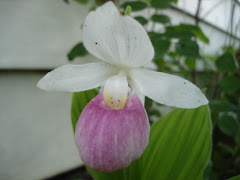
Cypripedium reginae
This is commonly called showy lady's slipper, the state flower of Minnesota. I bought this particular plant last June. It was a seedling from Heritage Perennials; these seedlings can be purchased from many major nurseries in my city of Edmonton, in the 4" blue pots distinctive of Heritage and with the big, colorful tags. These sell for $30 universally. Many gardeners who live in Canada and possibly the US will know what I'm talking about. Anyway, I've noticed that a lot of people want to buy these but hesitate because of their price and reputation of being difficult to grow. Let me tell you, in one year I bloomed this plant, and it looks fantastic! It wan't hard at all! This was not my first C. reginae. Also, $30 is low for a Cyp, and these will probably bloom in their second year in the garden.
I planted it in part shade (morning sun), on the east side of a building. You can also plant it under a tree. I used a mix of:
3 parts Premier Pro-Mix HP (which is basically 3 parts perlite, 2 parts peat)
1 part cactus mix (which is basically 1 part sand, 1 part gravel, 1 part peat or potting soil)
1 part compost
1 part grit or fine gravel, or coarse sand
1 part fine Paphiopedilum mix (4 parts fine bark, 1 part perlite, 1 part charcoal, 1 part peat)
Dolomite lime for pH adjustment (pH 7-8 required)
This mix filled a hole 12" deep by 12" wide, which had already had a 2" drainage layer of clay pellets added. Gravel or something similar can also be used for the drainage layer. Note also that the exact mix above does not have to be used; we just want a mix of similar consistency, which is free-draining but does not dry out rapidly. A constantly wet/stagnant mix will kill the plant. Yet, a bone dry mix will kill it quicker in the heat of the summer - this plant does like constant moisture. So, I water it enough to keep it moist, but not so much it stays saturated. It also likes lots of nutrients, and lots of calcium. So I apply bone meal twice a year, in the late spring as the plant starts into growth and in high summer after flowering, when the roots are actively growing. I also fertilize during the growing season with Miracle-Gro for perennials, though I hold off for 2 weeks after applying bone meal. This is done every 2 weeks until the fall.
This plant starts emerging in mid to late May in my region (zone 3) and is in flower by the end of June. In warmer regions it can be active up to 2 weeks earlier. It is always later than pretty much all other Cyps. The flowers last about 2 weeks and are fragrant, and large (larger than most yellow lady's slipper flowers). The plant has larger leaves and grows taller than yellows as well, to 3 feet when fully mature and established. Established clumps very commonly develop double-flowered stems. By October the plant is dormant in most regions. This plant will grow well in zones 3-7, zone 2 with protection and zone 8 in a fully shaded spot. It needs a 3-4 month winter dormancy.
Monday, June 18, 2007
Paph Lady Booth
A New Cyp parviflorum
Saturday, June 16, 2007
Paphiopedilum Wossner Armenijack
This is a fantastic new hybrid from subgenus Parvisepalum. It has a very large flower. In time, it should turn yellow, but for now, it's a lovely shade of green. It also has another bud coming. The plant is compact but the flower is held high, and it has beautiful mottled leaves with purple undersides. This is a cross between P. armeniacum and P. jackii.
Cypripedium parviflorum Gallery 2
Sunday, June 10, 2007
Sunday, June 03, 2007
Some More Pics
Orchids
I also have a few in bud: Paph Wossner Armenijack, Paph Joyce Hasegawa x chamberlainianum, and Phal Maki Watanabe. I haven't moved those outside yet, because I'm afraid the buds will drop. Once the flowers open they will be moved.
More Garden Photos
June 3 Garden Photos
Monday, May 28, 2007
Friday, May 25, 2007
Paph Avalon Mist
Change in Phrag Culture
I've repotted all my Phrags except Grande into a mixture of 4 parts paph mix (fine bark, charcoal, perlite) to 1 part PRO-MIX HP. This mix drains well but retains moisture. The rockwool is too hard to get, and I found it was too chunky and had to fertilize too often. Most importantly, it MOLDED! I've never had a bark mix mold. The Grande will be repotted as soon as I can get more mix.
Thursday, May 24, 2007
Cypripedium Ulla Silkens
Misc. Garden Photos
Wednesday, May 16, 2007
A Walk in the Garden
Subscribe to:
Posts (Atom)