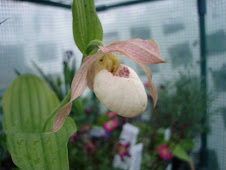
This is a new albino Maudiae hybrid, and likely my favorite of this breeding group. I love the way the dorsal ends in a sharp point, and the color is sharp and uniform. This photo was taken with my new DSLR camera.
Monday, March 23, 2009
Paph Yi-Ying Green Coral
This is a new albino Maudiae hybrid, and likely my favorite of this breeding group. I love the way the dorsal ends in a sharp point, and the color is sharp and uniform. This photo was taken with my new DSLR camera.

Sunday, March 15, 2009
A Pair of Paph villosums

 Illustrated above are two separate specimens of the same species - Paph villosum. You can see the variation possible within this species. Paph villosum is an old standard species that finds itself in most serious slipper orchid collections. It is easy to grow and its varnished look is quite unique.
Saturday, February 28, 2009
Cypripedium reginae


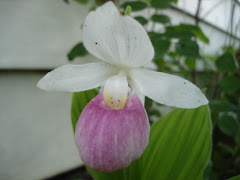
Cypripedium reginae, or showy lady's slipper, is a native Canadian orchid whose range extends from Saskatchewan into the maritimes, and south into the midwestern and eastern US. It was for a long time my favorite plant in the world, and it is still very high up there on my list. This is not the nicest reginae I have flowered but it remains very pleasant. I bought it in leaf at the OSA show last weekend; it flowered out very quickly (as Cyps do). It was forced out of dormancy to bloom much earlier than it normally does. In pot culture it is possible to do this by altering the plant's growth cycle. I will likely keep it this way, rather than planting it out, so that I can show it every year.
Monday, February 23, 2009
OSA Show 2009 Haul
This past weekend was my local orchid society's annual show and sale. I picked up the following plants:
Paph Yi-Ying Golden Slipper (in bud)
Paph Yi-Ying Green Coral (in bud)
Paph micranthum
Paph vietnamense (X2)
Paph druryi
Paph fairrieanum
Paph sanderianum
Paph rothschildianum
Paph emersonii
Paph bellatulum (in spike)
Paph (micranthum x jackii)
Paph Wossner Vietnam Star
Den loddigesii 'ROC' AM/AOS (in bloom)
Den New Century 'Happiness' (in bloom)
Den nobile (in bloom)
Den victoria-reginae
Den parishii
Cochleanthes candida
Leptotes bicolor (in bud)
Cyp reginae
Cyp Sabine
Otaara (LC Psyche x Ctna. Why Not)
Ecuagenera did not bring the Selenipedium aequinoctiale I pre-ordered, which flabbergasted be, especially after all the anticipation. However, I did pick up lots of great plants. There will be some photos posted soon!
Paph Yi-Ying Golden Slipper (in bud)
Paph Yi-Ying Green Coral (in bud)
Paph micranthum
Paph vietnamense (X2)
Paph druryi
Paph fairrieanum
Paph sanderianum
Paph rothschildianum
Paph emersonii
Paph bellatulum (in spike)
Paph (micranthum x jackii)
Paph Wossner Vietnam Star
Den loddigesii 'ROC' AM/AOS (in bloom)
Den New Century 'Happiness' (in bloom)
Den nobile (in bloom)
Den victoria-reginae
Den parishii
Cochleanthes candida
Leptotes bicolor (in bud)
Cyp reginae
Cyp Sabine
Otaara (LC Psyche x Ctna. Why Not)
Ecuagenera did not bring the Selenipedium aequinoctiale I pre-ordered, which flabbergasted be, especially after all the anticipation. However, I did pick up lots of great plants. There will be some photos posted soon!
Thursday, February 19, 2009
Update on the Paph. delenatii

It has now been a month since the first photo was taken of this plant, on its way to flowering for the first time. Atop a now 8" spike, the first bud begins to expand.
Tomorrow is my local Orchid Society of Alberta annual show and sale, this year entitled "Orchid Dreams". Expect lots of photos to be posted from the show and from new plants!
Friday, February 06, 2009
White Amaryllis
 I like to grow amaryllis bulbs during the winter; they are some of the most beautiful indoor plants and are very easy to care for, and you can store them during the summer for reuse. The good ones (like this one) have huge flowers - the flower pictured is over 7 inches across. The tall stalks can get top-heavy and sometimes need staking. To find a good-quality bulb, buy from a reputable garden centre, in bulk. Usually the cheap ones at Wal-Mart, etc. are not very good. As well, the special Christmas "kits" usually turn out quite poor. A strong bulb will be nice and big, probably around 5 inches or so in diameter. Smaller ones will have smaller flowers the first year but should get bigger if you keep them as perennials. Better cultivars and older plants will produce multiple flower stalks, as well.
The cultivar pictured is Hippeastrum 'Intokasie', from the Netherlands.
Thursday, February 05, 2009
Another delenatii Update
 It has now been two weeks since I first pictured this plant (in sheath), and the spike is now about 3 inches long.
Thursday, January 29, 2009
It's Coming Along...
 The Paph delenatii spike I posted on exactly one week ago has grown an inch. There appears to be a second bud forming underneath the large one.
Tuesday, January 27, 2009
Coming Soon: Selenipedium aequinoctiale
Selenipedium is a genus of only a few species of slipper orchids from Central and South America. They are gargantuan plants with small flowers, and very difficult to cultivate, so they are very difficult to find on the market. However, I think they are really special, and I am determined to become one of the few people in the world who owns one. As such, I have pre-ordered one from Ecuagenera, the only company in the world I know of that sells them, for delivery at the OSA's show next month. This species has orange and purple flowers, and grows 5-6 feet tall on slender, reedy stems. I am currently collecting information on the cultivation of this plant. More on this soon!
Monday, January 26, 2009
Extensive Website Updates
There have been some major updates to the website at http://members.shaw.ca/jgadbois. There are now several articles downloadable. Check it out!
Sunday, January 25, 2009
It is Finally Up, I Promise...
Over the past year or so I have gone through several attempts to get a website up and running, which would have more features than this blog. These have all failed - until now. After finally investing in a web design program, I have designed a website that is online. The address is http://members.shaw.ca/jgadbois - bookmark it! Perhaps one day I will have my own domain, but for now this is the best I can do. Over the next little while I will be getting all the features of the site working. The site will feature tons of downloadable content, including articles (in Word format) and maybe even wallpapers and video tutorials. The possibilities are nearly endless! Currently only very basic introductory information and a few photos are live, but check back often for updates!
Friday, January 23, 2009
Artificial Vernalization of Potted Cypripediums
A few days ago I took my Cyp. reginae f. albolabium seedling out of vernalization. This is the only Cyp that I have growing in a container currently, and I'm doing this because it is a fragile young plant - I never plant seedlings out until they are 2-3 years old. Anyway, I wanted to discuss the issue of dormancy in Cypripediums when you are container growing. This applies to seedlings and mature plants alike. Because Cyps are temperate plants, they require a cold winter dormancy in order to survive. During this period the plants die to the ground and rest for 3-4 months. Obviously in the garden nature takes care of this, but if you are container growing, you have to simulate it. The best option with mature plants, if they are hardy in your region, is to sink the pots into the ground for the winter. But if you are growing seedlings, this is undesirable as conditions outside are quite harsh for such tiny plants (although some people simply plant them in protected sites). As well, some people like to have mature Cyps growing at specific times of the year, ie for shows and such. Finally many people grow the more tender species in northern areas and can't overwinter them outside. In these cases, we use a method called artificial vernalization, in which basically the plants are refrigerated for a few months.
Cyps do not need freezing temperatures during their dormancy; in fact this might kill them in pots. Outside, the plants are insulated from the cold by the ground, mulch, and snowcover. In pots they don't get this insulation. So, temperatures of around 3-5 C are adequate for dormancy. Any standard refrigerator works for this. The next thing is soil moisture. Although the plants should have significantly less moisture during dormancy, they should still not be bone dry. As dormancy approaches (signalled by the yellowing of the leaves), gradually reduce watering so that by the time the plant is brown it is just being kept slightly damp. Now, place the pot in a Ziploc bag and seal it, and place it in the crisper drawer of the refrigerator. This will create a humid environment so that the soil doesn't dry out, and the bag should help keep fungi out. However, as there is moisture and there are cool temperatures, you could get mold growth on the soil so watch for this throughout dormancy and pick it out as it appears. I like to prick holes in the Ziploc bag to vent it, which I find helps reduce mold growth. This doesn't work as well for everyone though, I've heard. Also throughout the dormancy, check the soil moisture every once in a while and dampen it a little if it gets dry.
With mature plants, it is usually not feasible to refrigerate them because the pots are too big. For them, you probably have to store the pots in the garage (unheated) or a really cool room in the basement over the winter. In the case of an unheated garage, simply cover the pots really well with blankets, etc. to keep it from freezing.
And that's basically it! All you have to remember besides that stuff is that the plants need 3-4 months dormancy depending on the species (and formosanum appears to only need 2 months). When the time is up, just remove the pot from the fridge and start watering it (put it in a bright location). If the plant starts emerging from the soil while it is in the cold treatment, remove it immediately. I'll be posting pictures of my seedling in the coming weeks.
Cyps do not need freezing temperatures during their dormancy; in fact this might kill them in pots. Outside, the plants are insulated from the cold by the ground, mulch, and snowcover. In pots they don't get this insulation. So, temperatures of around 3-5 C are adequate for dormancy. Any standard refrigerator works for this. The next thing is soil moisture. Although the plants should have significantly less moisture during dormancy, they should still not be bone dry. As dormancy approaches (signalled by the yellowing of the leaves), gradually reduce watering so that by the time the plant is brown it is just being kept slightly damp. Now, place the pot in a Ziploc bag and seal it, and place it in the crisper drawer of the refrigerator. This will create a humid environment so that the soil doesn't dry out, and the bag should help keep fungi out. However, as there is moisture and there are cool temperatures, you could get mold growth on the soil so watch for this throughout dormancy and pick it out as it appears. I like to prick holes in the Ziploc bag to vent it, which I find helps reduce mold growth. This doesn't work as well for everyone though, I've heard. Also throughout the dormancy, check the soil moisture every once in a while and dampen it a little if it gets dry.
With mature plants, it is usually not feasible to refrigerate them because the pots are too big. For them, you probably have to store the pots in the garage (unheated) or a really cool room in the basement over the winter. In the case of an unheated garage, simply cover the pots really well with blankets, etc. to keep it from freezing.
And that's basically it! All you have to remember besides that stuff is that the plants need 3-4 months dormancy depending on the species (and formosanum appears to only need 2 months). When the time is up, just remove the pot from the fridge and start watering it (put it in a bright location). If the plant starts emerging from the soil while it is in the cold treatment, remove it immediately. I'll be posting pictures of my seedling in the coming weeks.
Thursday, January 22, 2009
Spring is Coming...
 Although it is bitterly cold outside today, I have hope, because this Paph delenatii, which is generally a spring bloomer, is spiking. This is a first bloom seedling from awarded parents. I am delighted to have it spiking so quickly after I bought it in October at the FOS show. It originates from Paphanatics, the famed Paph breeder. This is a sure sign of spring!
Monday, January 19, 2009
Phrag schlimii 'Allan's Red'

 It's always difficult to get a good picture of these because the flowers are petite and are often held at a weird angle. I have found that this species is quite variable in terms of flower quality. This is my second one, which I just bought yesterday. It's not much better than my other one, but as my other one is struggling and this is a robust division, I bought it. This is a difficult species to grow well - I think the key is to use pure water and keep it wet. I have to try to pay more attention to my schlimii plants so they do better - they are temperamental and need lots of TLC.
This species is quite hard to find, but all the serious Phrag growers/collectors have at least one. It is an old species and is obviously very attractive, and is one of the most compact Phrags there is, and a founding species of both pink Phrag hybrids and compact ones. Whilst being compact for a Phrag, this plant is still at least 16" or so in leafspan, and growing in a 1 gallon pot - they get rather large as they clump up and mature. Characteristically, the sequentially flowering stems are short and few-flowered. The flower is less than 2" across but has a light fragrance. While the single open flower on this plant looks ridiculous with so much foliage, when it clumps up more it will have multiple stems flowering at once which looks quite impressive. A specimen plant of Phrag schlimii is always a magnificent sight to behold. Here's to Colombia's most beautiful orchid (in my opinion)!
Mega Fanaticum and Something Enchanting

 I know, I know... I said I was going to CUT BACK on tropical orchids, but at this weekend's OSA meeting, I couldn't resist a couple exceptional plants. Pictured are Paphs Harold Koopowitz (malipoense x rothschildianum) and Fanaticum (malipoense x micranthum). I call the latter a "Mega Fanaticum" because the flower is HUGE - 4.5" x 4.5". It is in a vase because the stem broke on the vendor's way to the meeting, but he left it there to show off the plant's potential. You can't tell by the photo, but the pouch is actually collapsing from old age. He said the flower had already been open for about a month - pretty much as long as these last.
Harold Koopowitz is an example of what I call the ultimate Paph hybrid - a Parvi x multifloral cross. Paph rothschildianum always produces the best of these kinds of hybrids. They have enormous flowers on relatively compact plants, with great color and form - what more could you ask for? These flowers are nearly 7" across!
I also bought another Phrag schlimii at that meeting, which I will likely post on later. So much for cutting back... maybe I will build that growing room after all?!
Wednesday, January 07, 2009
A Need For Cutting Back
Of late I've been finding it increasingly difficult to manage my large collection of tropical orchids in the VERY small area that I have. As such, I am going to be selling off the majority of my tropical orchid collection at OSA meetings. I will be keeping 15 or so of my favorite (and rarest) plants, all of which are compact enough to grow in front of my windowsill. I had been planning to create a larger growing space in the basement, but have found that my unfinished, crawlspace basement is just not going to work out. I'm going to keep the large "plant cart" I've been using for most of my plants for future use, as I plan to eventually go back to a large collection when I move out of my parents' house. I guess it'll go into storage or something (disassembled)... I'm not totally sure yet.
I am going to focus now on hardy orchids (Cypripediums in particular), for which I have almost unlimited space in the garden outside. It's a shame, but I think my hobby will be a lot less tiresome in the long run. I had been hauling 75 plants across the house to the bathtub to water 3 or 4 times a week... now with only a few plants, it won't be hard to take them to the sink and water them. Plus, my plants won't control the house anymore! Of course I will continue to post photos and information on this blog. I am still working on some projects and even have some plants (that I'm keeping) in sheath right now.
I can't wait until Cyp season in May-June. I will get a little taste of the Cyps later this month, for a Cyp reginae albolabium seedling will be coming out of vernalization. This is obviously extremely early for it do be doing this; it's in a bit of a distorted cycle right now. In the next season I will try to get it on track. Then, in Februrary is the OSA show, where I'm hoping to add some Cyps to the collection. The excitement is difficult to bear!
I am going to focus now on hardy orchids (Cypripediums in particular), for which I have almost unlimited space in the garden outside. It's a shame, but I think my hobby will be a lot less tiresome in the long run. I had been hauling 75 plants across the house to the bathtub to water 3 or 4 times a week... now with only a few plants, it won't be hard to take them to the sink and water them. Plus, my plants won't control the house anymore! Of course I will continue to post photos and information on this blog. I am still working on some projects and even have some plants (that I'm keeping) in sheath right now.
I can't wait until Cyp season in May-June. I will get a little taste of the Cyps later this month, for a Cyp reginae albolabium seedling will be coming out of vernalization. This is obviously extremely early for it do be doing this; it's in a bit of a distorted cycle right now. In the next season I will try to get it on track. Then, in Februrary is the OSA show, where I'm hoping to add some Cyps to the collection. The excitement is difficult to bear!
Wednesday, November 12, 2008
Paph Satin Smoke


 This gorgeous hybrid owes most of its striking charisma to the Paph micranthum parent, which lends its large pouch with contrasting smaller tepals having pink-red stripes to the picture. The primulinum parent adds a slightly altered pouch and tepal shape (more slender), more subdued coloring (the pouch is ivory and the tepals a soft misty pink), a multifloral habit (2-3 sequentially opening flowers per stem), and ease of culture, which is a major drawback for micranthum. So what you get is a flower very similar to micranthum, but in greater numbers and appearing much easier than micranthum! I don't believe any of the hybrids made with micranthum are any better-looking than the species (not even Magic Lantern), but this is an amazing plant well worth seeking out. I have taken three photos of the same flower at different angles so one can fully appreciate the three-dimensional character of the bloom (which is a feature of any slipper orchid but especially with this one).
Tuesday, November 04, 2008
Phrag Sedenii 'Blush'

 Phrag Sedenii (longifolium x schlimii) is one of the oldest slipper orchid hybrids. It has stood the test of time better than most of the old crosses, likely because for about 70 years during the 20th century there were no Phrag hybrids registered and this was one of the few pink ones available. It is a very charming plant, albeit quite a large one, and can sometimes have a faint fragrance (as this one does). There are a few named cultivars of Sedenii, all of which are superior to unnamed ones, and this is one of the more common of those. It is one of my favorites, along with 'Candidulum' (made with schlimii f. album), which is lighter in color. The superiority of this clone is revealed not only in the proportions and color of the flower, but in its tendency to branch the spikes. It is also quite vigorous. This was one of my plants that was killed in last year's frost disaster, newly replaced from the FOS show a few weeks ago. It is a very promising plant.
Monday, October 20, 2008
Exciting Projects to Come


 As I believe I mentioned in a previous post, last month I pollinated some of my orchid flowers in preparation for an in-vitro seed propagation project. These are now forming capsules. From top to bottom: Dendrobium Thai Jeng x compactum; Doritis pulcherrima var chumpornensis; and Phalaenopsis Baldan's Kaleidoscope. These are all selfings as I had nothing from like genera to cross (although I realzied when it was too late that I could have crossed the Doritis with the Phal, which would have been interesting...). I would really like to cross some slippers in the future and I plan to do so as more flowers open. I already have relatively detailed plans in place for a propagation project of my Cypripediums in the spring, centred around my new propagation bed of Cyp. parviflorum var pubescens. I will posting about all of these projects as they develop.
The Products of Boredom


After a disappointing turnout of plants for sale at this month's OSA meeting and not a single vendor in town with a slipper orchid for sale, I've got the blues this week. I am very excited about the future of my growing hobby however, as it becomes more serious and I try to mold it into a career. This evening I was poking around my collection and decided to take some pictures of noteworthy findings.
The first pic is of one of my Paph micranthums, in sheath. I have 2 mature plants and three seedlings. This will be the first to flower. Probably the most exciting thing going on right now. If you haven't yet seen a Paph micranthum flower, seek one out!
The second depicts Paph Satin Smoke (micranthum x primulinum, on the left) and Paph malipoense x jackii (on the right), in spike. The former is a gorgeous multifloral with big smoky-pink blooms, while the latter is a very large-flowered Parvi primary with fragrant green blossoms.
The third portrays Paph ang-thong (also known as Paph godefroyae var ang-thong, Paph niveum var ang-thong and Paph x ang-thong), in low spike. This will be an adorable little white flower with maroon speckles.
The fourth displays Paph Winston Churchill 'Indomitable' FCC/AOS x gratrixianum, a complex hybrid which I last posted on last summer when it first bloomed. It is in sheath.
Finally the last two photos are the first I have taken of my carnivorous plant terrarium, my first attempt at growing these plants that seems to be successful (the last couple times I tried I failed eventually). The plants are growing very vigorously and appear to be very healthy. A closeup of a Nepenthes viking pitcher through the glass is the subject of the fifth photo, while the last gives a view of the entire setup from the outside. I will explain this setup some other time. For now, can you identify all the plants in the last photo? Visible are Nepenthes viking (tropical pitcher plant), Sarracenia pstittacina (parrot pitcher plant), Pinguicula moranensis (Mexican butterwort), Cephalotus follicularis (Albany pitcher plant, barely visible), Dionaea muscipula 'B-52' (giant Venus flytrap), and Dionaea muscipula (typical Venus flytrap). There is also an orchid residing in this tank, Leptotes unicolor, a Brazilian miniature which looks like it may bloom soon. There is one more plant in here which is not visible in the photos, Drosera capensis (cape sundew).
Subscribe to:
Posts (Atom)